Physics 464 (ECE 464 ), Laser Physics I
Mondays and Wednesdays, 14:00 to 15:15 pm, PAIS Room 1160
Fall 2026
Instructor
Jean-Claude Diels
Physics & Astronomy room PAIS 2236, phone 277 4026
CHTM, room 114A, phone 272 7830 email: jcdiels@unm.edu
Teaching Assistant
Yinmiao Wang
Reference material
Lecture content, followed by a link to the powerpoint file, and homework assignments will be posted on my personal Web site dielslab.unm.edu/courses.
References will be made to textbooks and articles, when appropriate. I follow the notations of the book “Ultrafast Phenomena” of which a link can be found before the first lecture.
Other reference material:
- Lasers: the Power and Precision of Light. Wiley-VCH" (2011) J.-C.~Diels and Ladan Arissian, Elementary introduction, no equations.
- LASERS, by Anthony E. Siegman, University Press --the "bible" of laser optics, to consult when designing a laser
- Laser electronics, J.Y Verdeyen, Prentice Hall classical textbook cherished by my colleagues
- Solid state laser engineering, W. Koechner, Springer verlag
- Photonics, Saleh
Assignments
Homework problems will be assigned on a regular base, due generally on Wednesdays. They will count for 40% of the final grade.
Some problems will be treated in class.
Exams Two midterm and one final (format to be decided); 60% of grade total.
Book "Ultrafast Phenomena"
INTRODUCTION
Putting Laser Light in Context
1. Light is just one example of wave . August 17
There are:
- Water waves
- Plasma waves
- Acoustic wave
- Light waves
- Gravitational waves
A wave propagate for huge distances, while each particle responsible for the wave motion stays at the same average position, just inducing the motion of the next particle.
In most cases, the wave starts from a local oscillation, and propagates radially from there, like rings produced by a duck paddling on a pond.
In the case of light, it is the electric field produced by a charge oscillating up and down that starts off the wave.
- Wave propagation equation (first order) Retarded frame
- Sine waves and “rogue waves”
- water waves, acoustic waves, gravitational waves and light waves Wave propagation equation
- Wave propagation equation: second order to first order - slowly varying envelope approximation
[Verdeyen Chapter 1]
[Ultrashort Laser Pulse Phenomena Section 1.2]
1 Link to powerpoint file (Lecture 1.ppt)
2. Notations August 19
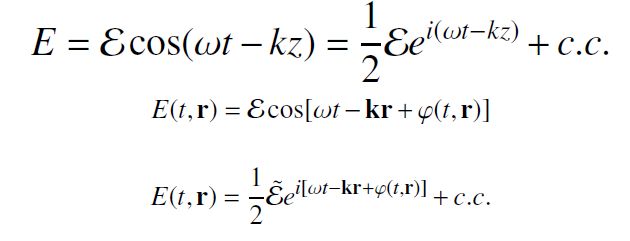
3. Complex representation of light field
3,1 - Instantaneous polarization. Phase of polarization - Frequency shifts
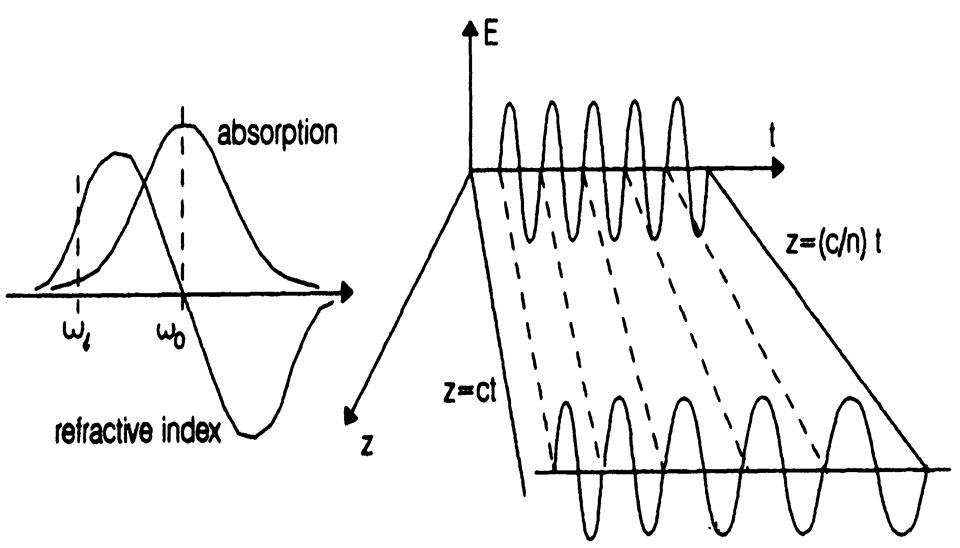
In time, even the light frequency is not conserved
Maxwell wave equation (review)
link to Maxwell (MAXWELL-STEP-BY-STEP.pdf)
3.2 Superposition of waves - coherence

2 Link to powerpoint file (Lecture 2.ppt)
DOPPLER SHIFTS (all waves)
Longitunal Doppler shift
Transverse Doppler shift
Review of Lorenz transformation in your favorite ENM textbook
WHAT CHARACTERIZES LASER LIGHT?
Dynamic range for
- Wavelength
- Time scales
- Energies and power
- Intensities
- Radiation pressure
- Linear and Angular momentum
3 Link to powerpoint file (8-23-phase.ppt)
Doppler shift, Angular momentum, Polarization
4 Link to powerpoint file (8-26-Doppler.ppt)
There is more than one way to skin a cat...
Angular momentum The laser Gyro
From Fourier Transforms to Wigner to Schroedinger
Review of Fourier Transforms
link to Fourier properties.pdf
Construction of single pulses and pulse trains --- Frequency combs --- Application of derivatives: FT of Maxwell's equations
CONVOLUTIONS: Square wave --- Measurement of continuous signals for a finite time --- Deconvolution ---
6 link to Fourier review_and-applications-8-31
How good is the slowly varying approximation? See homework I: applying the FT to Maxwell second orderr and first order. What is the “ultrashort pulse” limit? See homework II and link below:
7 link to few cycle pulse propagation
From Fourier transforms to Wigner Function, time bandwidth product
[Ultrashort Laser Pulse Phenomena Chapter 1 Section 1.5]
Quantum Mechanics in a few slides; uncertainty relations
[Ultrashort Laser Pulse Phenomena Chapter 5 Section 1]
Quantum mechanics, Cohem Tannoudji Vol 1.
8 link to Wigner function
LIGHT-MATTER INTERACTION
WHAT IS THE POLARIZATION?
Light-matter interaction: the light field moves the electron. The field of the moving electrons adds to the applied light field.
CLASSICAL APPROACH; 1) BOUND ELECTRON The harmonic oscillator model. A good lecture is in: web.ics.purdue.edu/~nowack/geos557/lecture3a-dir/lecture3a.htm Other references: Pedrotti page 535-539 (chapter 25) Born and Wolf: pages 95-99 (7th edition).
2) FREE ELECTRON (Plasma)
TEST 1 Monday September 21, room 1160
HOMEWORKS